Introduction
위치 ㅣ수원시 장안구 율천동 487-1
용도 ㅣ유치원
층수 ㅣ3층
Location ㅣ487-1, Suwon-si, Gyeonggi-do, Korea
Program ㅣ Kindergarten
Floors ㅣ3F
Agenda
유치원의 목적은 무엇일까?
대부분의 부모님들은 자신의 아이가 더 똑똑해지는 것을 바라서 유치원에 보내지 않는다. 일반적으로 부모님들은 아이들이 처음으로 가정이 아닌 사회에 나와 스스로 관계를 쌓아나가는 방식을 배우고, 남과 소통하는 방법을 익히기 위해 유치원을 보낸다고 생각한다. 아이들의 경우 처음에는 부모님이 보내서 가게 되는 경우가 대다수지만, 다른 친구들과 놀고 배우며 새로운 경험을 하기 위해서라는 이유가 유치원을 다니며 생긴다.
따라서 아이들이 소통하며 놀 수 있는 밝고 경쾌한 느낌의 놀이공간이 메인이 된다면 부모님과 아이들 모두가 유치원에 보내고, 가고 싶게 만들 수 있다고 생각한다.
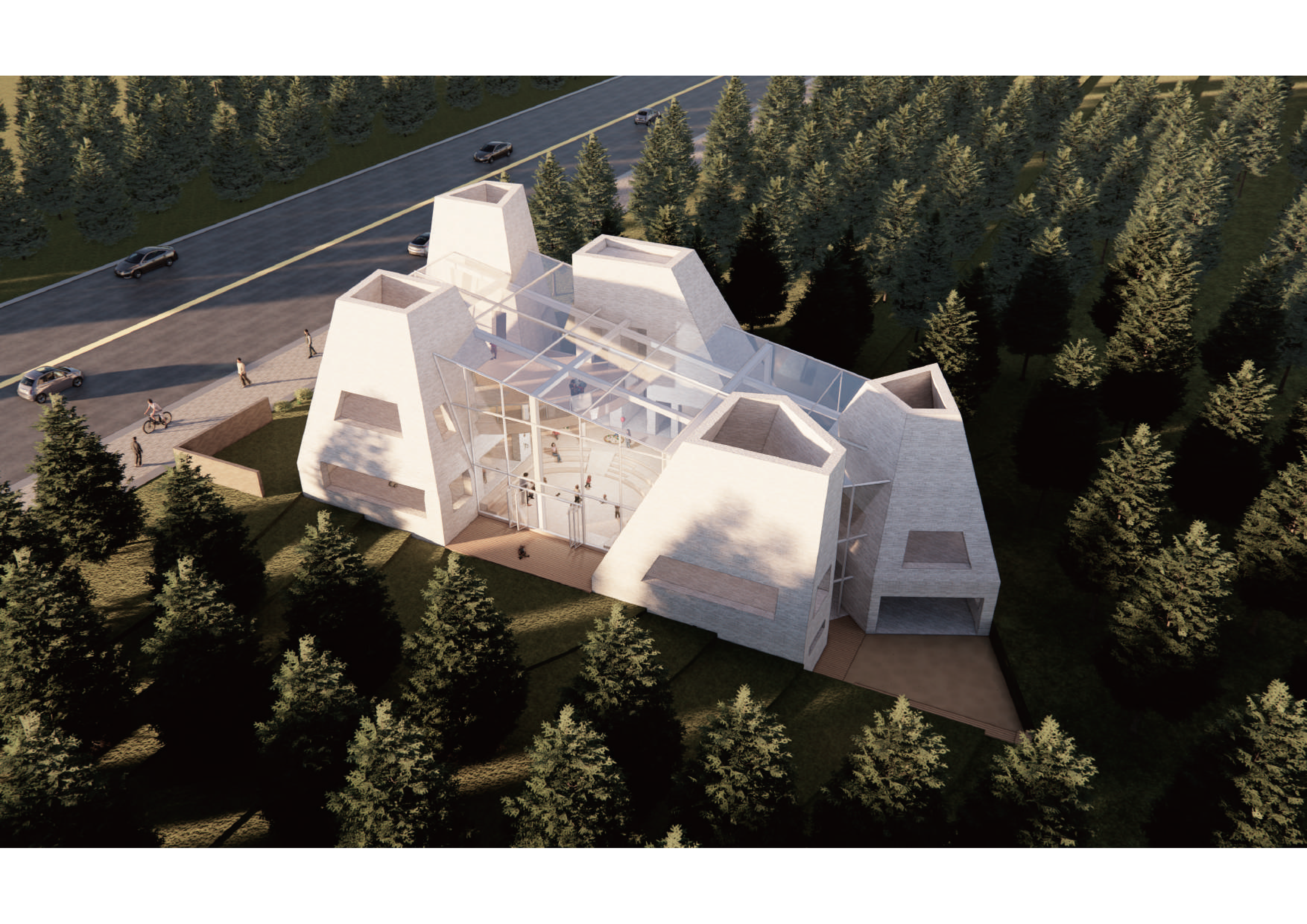
학년에 따라 수직적으로 나눠진 공간과 심심하고 재미없는 수직 벽, 어둡고 좁고 긴 통로는 말만 들어도 아이들이 따분해하고 지루해하는 요소이다. 따라서 벽이 기울어지고, 다른 나이의 어린이들이 함께 모여 놀 수 있는 밝고 탁 트인 놀이공간, 또 외부로 다양한 동선을 추가해 호기심을 자극하는 문들을 설계 요소로 정했다. 이렇게 광장형 놀이공간을 중심으로 한 소마을 형식의 유치원을 설계하게 되었다.
What is the purpose of a kindergarten?
Most parents don’t send their children to kindergarten simply to make them smarter. Generally, they hope their children will learn how to build relationships independently, outside the home, and how to communicate with others. For the children, while they may initially attend because their parents send them, they soon develop their own reasons—such as playing with friends, learning, and having new experiences.
Therefore, I believe that creating a bright and lively play space where children can communicate and have fun together will make both parents and children want to be part of this kindergarten.
Vertically separated spaces by grade, dull and uninviting walls, and dark, narrow, and long corridors are all elements that children find boring and tiresome. In contrast, I chose to incorporate tilted walls, bright and open play areas where children of various ages can gather and play together, and multiple external circulation routes with doorways that spark curiosity.
This led to the design of a small village-style kindergarten centered around a plaza-like play space.
Concept


아이들이 항상 밝고 즐거운 공간에서 놀 수 있도록, 가장 많은 시간을 보내는 교실을 놀이 공간을 중심으로 배치하여 놀이 공간이 유치원의 중심이 되도록 했다. 이 과정에서 남동쪽의 녹지와 저수지의 이점을 살리기 위해 보조 출입구를 남동쪽에 두었으며, 지형의 흐름에 맞춰 서쪽은 높고 동쪽은 낮게 매스를 불규칙하게 배치하였다.
In order for children to always be able to play in a bright and cheerful place, the classroom where they spend the most time was arranged to surround the play area, making the play area the center of the kindergarten. In this process, in order to maintain the advantage of the green space and reservoir in the southeast, the auxiliary entrance was placed in the southeast, and the mass was irregularly arranged so that the west side was high and the east side was low in accordance with the flow of the land.
또한, 매스와 보이드 사이의 대비는 극적인 느낌을 만들어낸다. 아이들이 수업을 마치고 나오면 햇빛을 느끼고 유리 온실을 통해 하늘을 직접 볼 수 있다. 비가 오는 날에는 유리에 떨어지는 빗방울도 관찰할 수 있다. 유리 온실은 단순히 매스를 연결하는 역할뿐만 아니라 수평 동선, 수직 동선, 나아가 놀이 공간의 역할도 수행한다.
Also, the contrast between solid mass and void mass makes dramatic feeling. when children finish their class and come out, they feel the sunlight and can directly see the sky through glasshouse. When it rains, children can see water droplets falling on glass too. The glass greenhouse not only serves to tie together the solid mass, but also serves as a horizontal passage, a vertical passage, and finally a play area.
Site Analysis


Program


Isometric

중앙 매스에 코어 역할을 하는 엘리베이터와 화장실은 동선을 단순화하기 위해 배치되었지만, 2층의 놀이 공간과의 관계를 고려하여 2층에 한해서는 화장실 대신 교사실로 변경하였다. 엘리베이터는 중앙에, 계단은 양쪽에 배치되어 있어 어디서든 동선이 얽히지 않고 쉽게 이동할 수 있으며, 좁고 어두운 계단 대신 유리 온실 안의 계단을 이용해 쾌적한 공간을 만들었다.
The elevator and restroom, which serve as cores in the central mass, were placed in order to simplify the facilities, but considering the relationship with the play area on the second floor, only the second floor was changed to a teacher’s room instead of a restroom. The elevator is in the center, and there are stairs on both sides, so you can move easily without getting tangled up in the path anywhere, and instead of narrow and dark stairs, the stairs in the glass greenhouse were used to create a pleasant space.
Drawings


Maquette


Rendering


credit